
I had just launched ainclave.com, ran a backlink report, and got one row back: a .ru redirect page with 44 outbound links and a spam score of 40. It pointed to my homepage with the anchor text "Ainclave.com".
That result didn't make sense at first. I had added the site to our GitHub organisation profile, several repositories, LinkedIn, and Mastodon. Four places linking to the domain, yet the report showed none of them.
I could have waited for another crawl and assumed the tool was behind. Instead, I checked the links themselves.
This is what I found, plus a small script you can use to check any page in about thirty seconds.
At some point, I picked up the idea that a link in a GitHub README counts as an SEO backlink. You see this advice everywhere in developer SEO guides: add your site to GitHub and get a free link from a high-authority domain.
That included the repository's Website field in the About sidebar. I had assumed GitHub might treat that one differently. It doesn't.
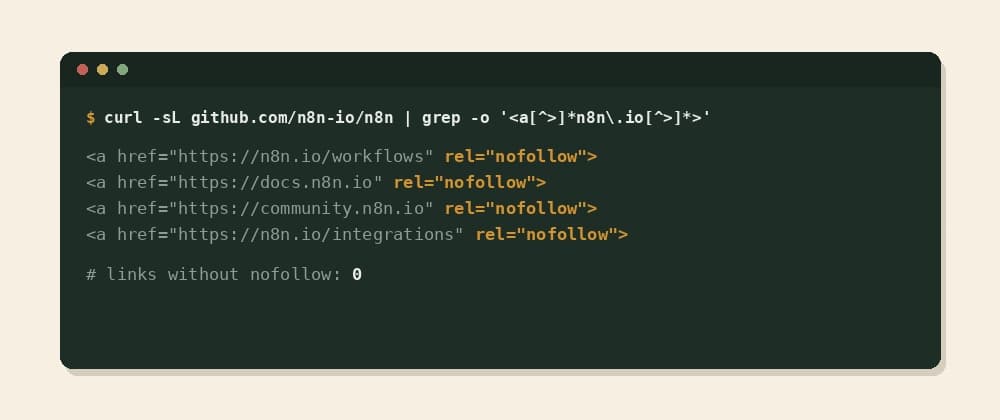
I repeated the check on my own organisation page. GitHub rendered eight links to my site, including the profile URL with itemprop="url". All eight had rel="nofollow".
GitHub applies this through its HTML sanitiser. It affects user-generated content across the platform: READMEs, About fields, issues, pull requests, discussions, wikis, and gists. There is no repository setting that turns it off.
Two details in that script are load-bearing, and I got both wrong on my first attempt. More on that below.
I used the same method on each site. These were the results when I checked; platforms can change their link policies, so I would rerun the test before relying on this table.
| Where | Result | |---|---| | GitHub README, About field, issues, gists | nofollow throughout | | LinkedIn company page website field | nofollow; much of the page is also closed to crawlers | | Mastodon profile metadata | rel="me nofollow noopener"; many instances also use noindex | | dev.to article body | no rel attribute | | Hacker News front-page story links | no rel attribute | | awesome-selfhosted.net | 72 external anchors, none with nofollow |
The awesome-selfhosted list is maintained on GitHub. Links on the GitHub version are sanitised like other user-generated links. But the rendered version on awesome-selfhosted.net is generated as the maintainers' own HTML, so those links do not inherit GitHub's attributes.
The distinction is simple: GitHub sanitises content displayed on github.com. It does not control HTML that someone publishes on a separate site.
A site on username.github.io contains your HTML. GitHub Pages does not run your outbound links through the same content sanitiser used on github.com.
No rel attribute. The page had seven outbound links, and none were marked nofollow.
That does not mean you should throw up a page containing nothing but links to your main domain. A thin page built only to pass link equity is unlikely to help and may look like a doorway page.
Give it a reason to exist. Mine contains a technical comparison that can stand on its own. The links point to supporting material rather than making up the whole page.
I also set the canonical URL to the GitHub Pages page itself. Pointing rel="canonical" at the main site would tell search engines that the page is a duplicate and that another URL should be indexed instead. That would work against the reason for publishing it separately.