
This is a submission for DEV's Summer Bug Smash: Clear the Lineup powered by Sentry.
The front-page lesson: A green “success” proves that an operation finished. It does not prove that its result is still there.
IN THIS EDITION The project · The incident · The patch · The safeguards · The signal
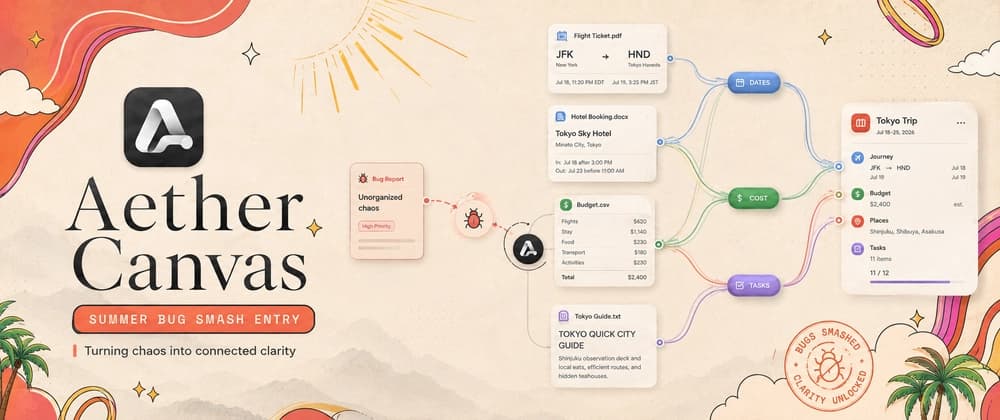
It is a local-first Electron application where spatially grouping ordinary files creates the mini-app you need. Put a flight confirmation, hotel booking, budget, packing list, and city guide together, for example, and Aether turns the cluster into a living trip workspace with routes, spending, tasks, and places—all traceable to the source files.
But the build was anything but simple. It was a one-week hackathon, and those seven days had to cover validating the idea, designing the architecture, building the interface, connecting the AI workflow, testing the main experience, and preparing the final demo and presentation.
We shipped a working product. We did not have enough time for deep concurrency and persistence stress testing.
WHAT WE SHIPPED A real local-first Electron product: spatial files, AI-generated workspaces, autosave, persistence, and a polished demo path. WHAT THE CLOCK HID The main experience worked, but the one-week schedule left little room for simultaneous-operation and shutdown stress tests.
I also chose not to modify the original submitted repository before the winner announcement. I wanted the artifact being judged to remain exactly as submitted. Instead, I created a separate Bug Smash repository, with the submission preserved at commit 3163641a and tagged openai-hackathon-submission.
That gave me something unusually valuable for debugging: an untouched before state.
Aether stores each workspace in its own JSON file and keeps a separate index containing the workspaces visible in the sidebar.
The original implementation already used atomic temporary-file replacement and a write queue. At first glance, that looked safe. After tracing the workspace IPC calls, autosave path, rename path, and persistence service, I found the boundary was in the wrong place.
✓ WHAT WAS SAFE Each individual JSON replacement was atomic. A partial write would not leave behind a half-written index. ✕ WHAT WAS NOT SAFE The read and modification happened before the queued write, so two complete operations could still overwrite one another.
But updating the workspace index is not one write. It is a complete read → modify → write transaction:
Two operations could read the same old index before either write entered the queue. Both would make a perfectly valid update. Both writes would complete successfully. The last valid-but-stale snapshot would win.
Just a workspace file that still existed on disk but was no longer reachable from the application.
I did not want to hammer the UI with clicks until I got lucky. I built deterministic before/after harnesses that run the same workloads against two real implementations:
🔴 BEFORE Loads the authentic workspace service directly from submitted commit 3163641a with git show—not from a hand-written broken copy. 🟢 AFTER Loads the repaired service from the Bug Smash branch and subjects it to the exact same operations and assertions.
The workload creates 40 workspaces simultaneously, then runs 20 autosave-versus-rename races. Each stage uses an isolated temporary Electron profile, opens the real desktop UI with the resulting data, and deletes that data after the window closes. My actual Aether spaces are never touched.