
That rule is easy to state and hard to test, because the thing making the judgment is a language model, and a language model is not deterministic. I sent TypeSafe's Jev the identical request five times and got back 0.03, 0.03, 0.03, 0.04, 0.04. Any property checker built on exact comparison calls that a failure and is useless.
So I built the thing the way I would build a database: a TLA+ spec first, model-checked until the quorum bound fell out of the math; an AsyncAPI contract derived from the spec; Rust generated from the contract; and Jev behind a single trait as the oracle. Then I ran 1,680 simulated pharmacy decisions through it under seeded chaos and counted how many times it was confidently wrong.
Zero. But two of the bugs I found along the way were mine, and the third is a limit the model cannot cross. That part is the article.
Jev (TypeSafe's "System One" model) does not return prose. Ask it whether oxycodone is a controlled substance and you get 0.98, not a paragraph saying so.
That one property is what makes the rest possible. A number has a noise floor you can measure. A paragraph does not. Once you can measure the noise you can gate on it, replay it, and prove things about the protocol wrapped around it.
Measured over 1,490 captured calls to jev-1.13.0, every one stored verbatim with a SHA-256: Not deterministic, but the jitter is bounded: identity floor 0.042, question-reorder 0.059, paraphrase cohort 0.073. Calibrated: accuracy 0.979, Brier 0.0187 on 240 constructed items. Latency flat in question count: 1 question 96.7 ms, 38 questions 98.0 ms. Billing meter linear to within one token across a 2,500× range.
The spec. Paxos and Raft assume a correct process's proposed value is stable. With a noisy oracle that assumption is false, and Byzantine models do not capture it either: the agent is not lying, the oracle is noisy. So the spec models vote instability as normal behavior, and the invariant is:
A vote is stable when its margin from 0.5 exceeds the measured noise floor. TLC finds the naive rule (decide on any quorum) violates this in four states. The stable rule holds at 1,049,750 distinct states with five agents, quorum three, and two crashes.
The quorum bound was derived, not copied. I wrote the safety invariants, then swept TLC across 24 configurations of (agents, byzantine, quorum) and printed predicted vs actual per cell. Safe iff 2Q > N and Q > 2f. My first guess was wrong; the sweep corrected it. In the Rust, QuorumPolicy::new is the only constructor, so a configuration TLC proved unsafe cannot be built.
The kernel. 48 tests, including replays of TLC counterexample traces. One test I would point a reviewer at first: calibrationchoicechangesthe_outcome. Identical probabilities decide under the identity floor and escalate under the cohort floor. The measurement changes the behavior, which is the whole point.
Fourteen pharmacy scenarios in three tiers. Golden cases a pharmacist answers without hesitation. Nuanced cases that are harder. Ambiguous cases with no defensible answer, where the correct move is escalation.
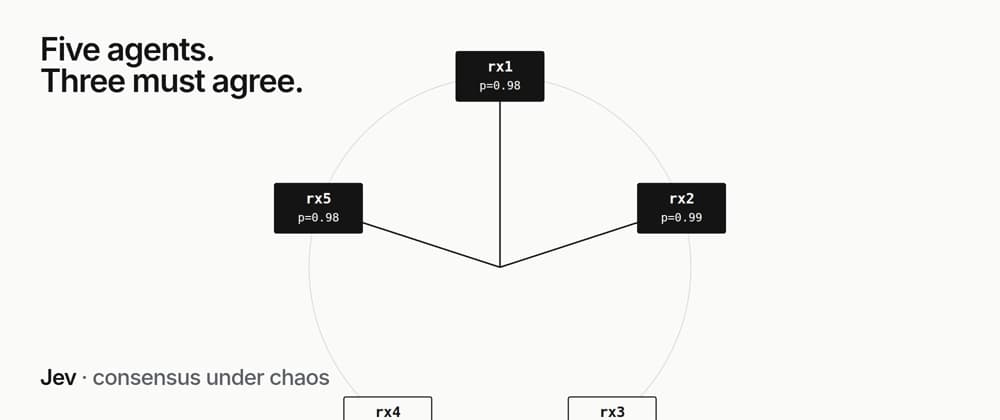
Five agents, each asking a different paraphrase of the question. Quorum of three stable votes. And a deterministic chaos layer driven by one seed: adversarial text spliced into patient records, records truncated mid-sentence, agents crashed before the round, rate limits, transport errors. Any failing round replays exactly.
| chaos | golden rounds | correct | escalated | wrong | |---|---:|---:|---:|---:| | none | 360 | 360 | 0 | 0 | | realistic | 360 | 360 | 0 | 0 | | severe | 360 | 314 | 46 | 0 |
Zero wrong verdicts in 1,080 golden rounds bounds the true rate below 0.28% at 95% confidence. That is the rule of three. It does not prove the rate is zero, and I am not going to round it up to "safe."
The escalation rate rose from 5.0% to 18.0% under severe chaos (z = 6.83). The kernel declines more as evidence degrades. That is the designed direction.
My favorite round: documented penicillin anaphylaxis, new order for amoxicillin. A first-year student answers that. Under chaos, two agents got rate-limited, a third came back at 0.54, sitting inside the noise floor. Quorum not met. The kernel sent it to a human.
Five agents on one prompt are one agent. I measured it: identical prompts across five agents spread by 0.010, inside the 0.042 floor. That is not five judgments. It is one judgment sampled five times, and it guts the Byzantine math, because Q > 2f assumes independent failures. Paraphrasing raised the spread to 0.080 on hard cases.
Then I audited the paraphrases against records with known answers and found two that were not paraphrases. "Can pregnancy be excluded on the basis of this record alone?" scored 0.36 on a negative hCG. "Alone" reads as a challenge to whether one test suffices. Jev was reading correctly. My question was different from the one I thought I had asked.