
Not "AI-assisted." Not "copilot suggestions I edited." I mean I made a rule: for 30 days, I don't type application code. The AI does. My job is to describe, review, and approve.
I shipped a real product this way — a small SaaS with auth, Stripe billing, a dashboard, and a public API. It works. It's in production. And along the way I found out exactly where the "AI writes everything now" dream holds up and where it quietly falls apart.
To keep myself honest: I don't write application logic by hand. I prompt, the AI writes. I can read every line, reject it, and ask again — but I can't fix it myself in the editor. Config, secrets, and "click the button in the dashboard" steps are mine (the AI can't do those anyway). If I get truly stuck for more than an hour, I log it as a "break" and write the code myself.
Let me be fair to the machine first, because a lot of this genuinely surprised me.
Greenfield scaffolding is basically solved. "Set up a Next.js app with Postgres, Drizzle, and auth" — done, correctly, in one shot. The first 40% of the project flew by faster than I've ever built anything.
Boilerplate it never gets wrong. CRUD endpoints, form validation, Zod schemas, a table component with sorting and pagination. This is the stuff I hate writing and it produced it perfectly, every time, no notes.
It's a phenomenal rubber duck. "Why is this query slow?" got me a better answer than I'd have reasoned to alone — it spotted a missing index and an N+1 in the same breath.
For the first week I genuinely thought I'd write the "developers are obsolete" post. Then week two happened.
The AI is brilliant at the file in front of it and blind to the one three folders over. It happily wrote a second formatCurrency helper because it didn't know the first one existed. It re-implemented my auth check inline instead of using the middleware I already had. It introduced a subtly different User type in a new module.
None of these are "bugs" — everything compiled, everything passed. They're architecture drift. And architecture drift is invisible until the day it costs you a week.
The scariest failures weren't crashes. They were code that looked right and ran fine on the happy path.
The billing webhook handler it wrote acknowledged Stripe events before persisting them. Works perfectly in testing. In production, a DB blip = a paid customer with no access and no record. I only caught it because I've been burned by exactly this before. A junior copying this AI's output would not have caught it. That's the part that keeps me up.
When something broke that the AI couldn't see, asking it to fix it produced changes, not fixes. It would confidently rewrite the function, swear the bug was gone, and reintroduce it two prompts later. Without the ability to drop into the debugger myself and actually understand the state, we'd have spun forever. This was the single biggest time sink of the month.
Asked for a settings page, it gave me 14 options no user asked for. Asked for error handling, it wrapped everything in try/catch and swallowed the errors. The AI's instinct is to add. Knowing what to leave out — the actual product-design part of engineering — it has none of.
Getting to "demo works" took a week. Getting to "handles a real user doing something weird at 2am" took the other three. Edge cases, race conditions, the empty state, the error state, the "what if they double-click" state — the AI does none of this unless you know to ask, and knowing to ask is the job.
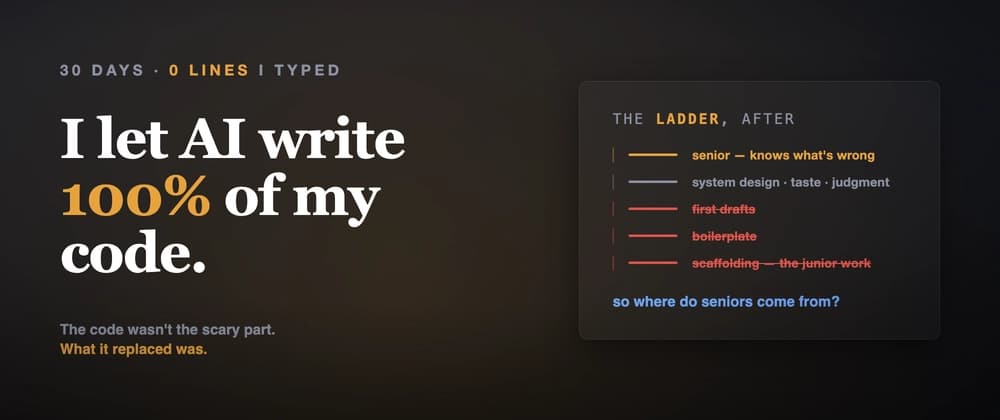
AI didn't replace me. It replaced the tasks I used to give juniors. The scaffolding, the boilerplate, the first draft — that's exactly the work a junior learns on. And that's the real problem nobody's pricing in: if the AI does all the entry-level work, where does the next senior come from? You can't skip the 10,000 hours; you can only move where they're spent.
The skill that mattered every single day wasn't writing code. It was: Knowing the code it gave me was subtly wrong. Knowing what to not build. Holding the whole system in my head so I could catch the drift.
Those are all senior skills. Which means AI didn't flatten the hierarchy — it made the top of it more valuable and kicked away the ladder to get there.