
I got the rejection email on a Tuesday. I've been rejected before — everyone has. This one broke something.
"While your technical skills are strong, we felt your reliance on AI tools during the assessment didn't reflect the independent problem-solving we're looking for."
By a man who — forty minutes earlier, on the same video call — had quietly done the exact same thing right in front of me.
Screen shared, camera on, the usual. A medium problem: parse some messy input, transform it, return something structured. Nothing exotic. The kind of thing I do at my actual job every single day.
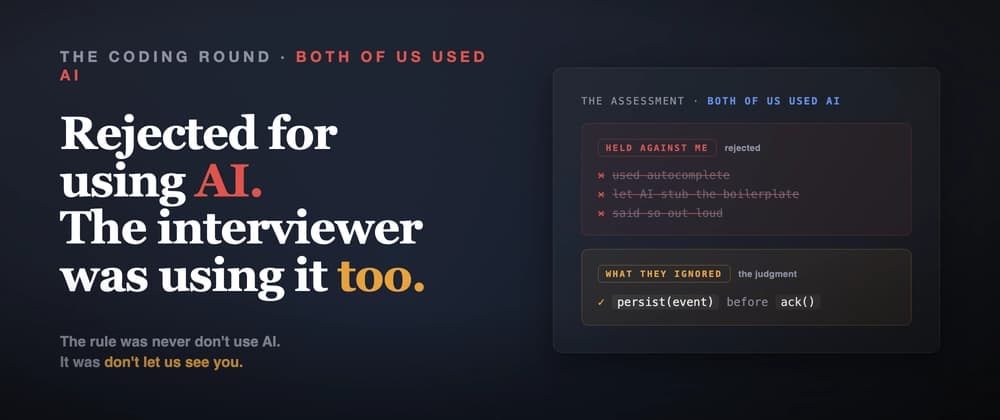
So I did it the way I do it every single day. I broke the problem down, wrote the core logic myself, and let the assistant stub the boilerplate so I could spend my attention on the edge cases. And I said so, out loud, on the call: "I'll let the assistant scaffold this part so I can focus on where it'll actually break."
I wasn't hiding anything. That, it turns out, was the mistake — thinking honesty was the safe choice.
I didn't clock it in the moment. You never do. You just feel a small temperature drop on the other side of the glass and tell yourself you're imagining it.
The flick. The half-second reading pause. The answer that came back a beat too clean, too structured, too formatted to be something a person says off the top of their head on a Tuesday afternoon.
I'm not going to pretend I could read his screen. But I've used these tools every day for two years. I know exactly what someone reading a generated answer looks like, because I look like that too. He was reading an AI's answer while quietly marking me down for reaching for one.
Pretend you didn't. Perform the 2019 version of yourself. Hide the tool that everyone in the room — interviewer included — is already using. They didn't reject someone who couldn't do the work. They rejected someone who was honest about how he does it. Those are not the same person, and only one of them is a problem.
They believed they were testing whether I could solve the problem without AI. But that's a test for a job that no longer exists. Nobody on their team ships without AI. He couldn't get through a follow-up question without it.
The test that would have actually told them something is the opposite one: give me the AI, then watch whether I can tell when it's lying to me.
Because that's the only skill that survived a year of me leaning on these tools as hard as humanly possible. A month ago I ran an experiment where I let AI write 100% of my code for 30 days and refused to type a line of application logic myself. It shipped a real product. And the thing that made it shippable wasn't the AI — it was the times I looked at a clean, confident, plausible diff and said no.
During that same round, before the boilerplate, I'd flagged something in the problem's framing: the write path needed to persist before it acknowledged, or a retry could double-count. It's the exact ack-before-persist bug that bit me during the 30-day run — the one where acknowledging before you save leaves a paying customer locked out with no record on a bad day.
No AI gave me that. I earned it the slow, expensive way, years before any of this. It's the thing that would have been worth an entire interview.
There are two different things hiding inside the word "coding," and hiring is still pricing them as one. Recall — the syntax, the API, the flag order, the incantation. AI has made this obsolete, and good riddance; it was never the valuable part. Testing for it in 2026 is testing for penmanship. Judgment — knowing what to build, what to distrust, what breaks at 2am when a real person does something strange. AI cannot hand you this. You can only earn it by doing the work AI now does for you — and you can only demonstrate it by catching the AI when it's wrong.
An interview that punishes you for using AI is measuring recall and calling it character. An interview worth passing hands you the AI and measures whether you can overrule it.
I didn't quit AI over one bad interview. It still writes 100% of my code and always will — the typing was never the hard part, it just felt like it was.