
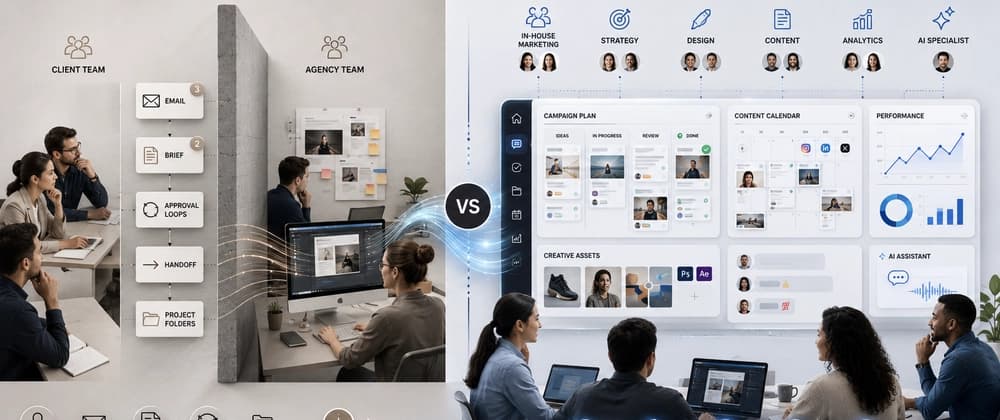
For years, marketing teams had a fairly simple choice: build everything in-house, or hire an agency.
But modern creative work rarely fits neatly into either model. Looking at the range of brand strategy, creative campaigns, and marketing work in Agency Squid's portfolio shows how closely strategy, creative execution, and specialist expertise often need to work together.
Today, marketing teams are expected to manage brand strategy, content, social media, campaigns, digital experiences, analytics, AI tools, production, and dozens of smaller tasks that rarely fit neatly inside one department.
Hiring a full-time specialist for every capability can become expensive. Handing everything to an outside agency can create another problem: distance from the business.
Instead of choosing between an internal team and an external agency, brands combine both.
A hybrid agency works closely with an organization's internal marketing team instead of operating as a completely separate vendor.
Brand knowledge Business priorities Internal approvals Customer insight Long-term strategy
Creative specialists Strategy support Campaign development Design and production Additional capacity Skills the internal team does not have
Instead of sending a brief to an agency and waiting for finished work to return, the external specialists become part of the working process.
They may use the same project-management system, participate in planning meetings, collaborate directly with internal marketers, and work through the same feedback cycles.
The result is somewhere between an internal department and a traditional external agency.
The agency's account, strategy, creative, and production teams develop the work.
In fact, separation can be useful when a company wants an independent perspective.
The challenge appears when marketing needs to move continuously rather than campaign by campaign.
A small change that could take ten minutes internally might require emails, meetings, account management, revisions, and another approval round.
The easiest way to understand the difference is to look at how each model behaves in practice.
Traditional agency: Communication generally moves between the client and designated agency contacts.
Hybrid agency: External specialists may communicate directly with relevant members of the internal team.