
I stored passwords in plaintext on a floppy disk in the 1980s. Recently, a coding agent made a version of the same mistake.
When I was running bulletin board systems in the 1980s, password management could be remarkably straightforward.
A user created an account. They chose a password. The BBS needed to determine whether the password they entered later was the same one they had chosen.
Hard drives were expensive and hardly universal in the hobbyist computing world I inhabited, so there was nothing strange about application data living on floppies. The important thing was that the software could retrieve the password and compare it against whatever the user typed the next time they called in.
So people started solving that. Maybe the password should not be stored exactly as the user entered it. A substitution cipher or some other homegrown transformation could at least stop someone from casually opening the user file and reading every credential.
The transformation might be reversible. Two users choosing the same password produced the same stored value. A compromised file exposed everyone at once. Users reused those passwords elsewhere. Password recovery introduced an entirely separate collection of problems.
Over the following decades, "store a password" accumulated an extraordinary amount of engineering knowledge.
Today, saying an application needs authentication describes far more than comparing one string against another. It means hashing, salts, password reset, expiring tokens, single-use tokens, session invalidation, account enumeration, brute-force protection, cookie attributes, CSRF, rate limiting, and a long list of other concerns depending on the threat model.
The first thing developers learn about frameworks is that they save us from writing code.
A mature framework does not merely contain code somebody else wrote. It contains decisions somebody else already had to make, edge cases somebody else already hit, vulnerabilities somebody else already discovered, and fixes somebody else already learned were necessary.
A relatively inexperienced developer can understand that flow and implement a version of it.
Production authentication is not hard because the happy path is hard. It is hard because of everything surrounding the happy path.
How should the password be stored? What happens after repeated failed attempts? Can an attacker determine whether a username exists by comparing error messages? What happens to existing sessions after a password change? How long should a reset token remain valid? What happens after it is used? Can it be replayed? What attributes belong on the session cookie?
The developer writing authentication for the first time does not necessarily know to ask any of that.
Software has always progressed partly by taking things that required specialized knowledge and putting them behind abstractions.
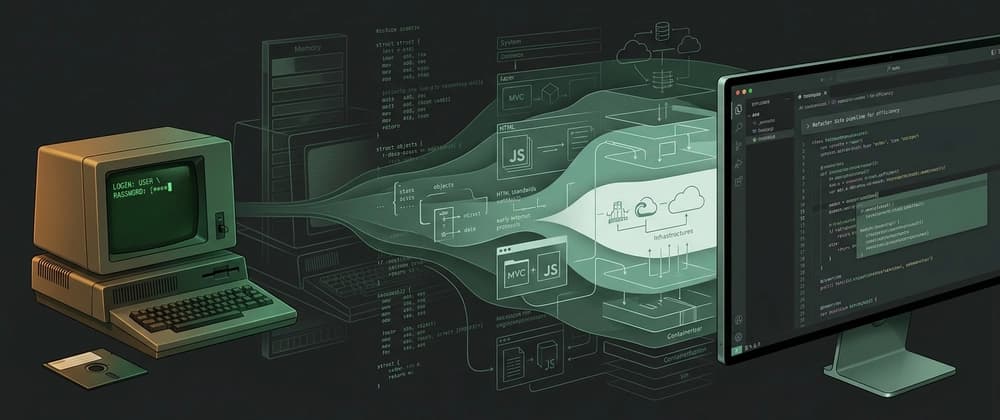
Assembly gave me extraordinary control over what the processor did. It was also a tremendous pain. Higher-level languages let us express more sophisticated ideas without manually considering every instruction. C retained substantial control over memory and execution while being far more productive. Later languages and runtimes provided increasingly sophisticated abstractions for memory management, type safety, concurrency primitives, and networking. Libraries and frameworks moved the boundary again. Managed platforms moved it again.
Your Python application still causes a processor to execute machine instructions. Your Django application still communicates over networks. Your application on a managed platform still runs on computers somewhere.
C gives me more control over memory. Running directly on infrastructure gives me more control than a managed platform. Writing SQL gives me more control than an ORM. Building against browser automation primitives gives me more control than a higher-level testing abstraction.