
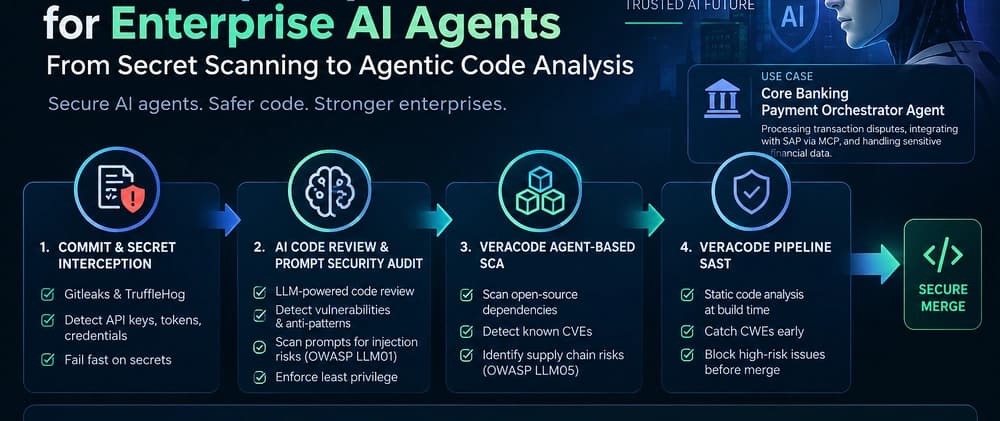
The rapid rise of autonomous AI agents — systems capable of dynamically invoking external APIs, generating code, and manipulating database state — has fundamentally altered the enterprise software supply chain. While traditional microservices operate on predictable, deterministic code paths, agentic architectures combine standard backend code with non-deterministic prompt templates, dynamic function-calling schemas, and rapidly evolving third-party SDKs.
Consequently, deploying agentic applications using legacy, unhardened CI/CD workflows introduces critical attack surfaces:
• Exposed Model Credentials and Tokens: Developer teams iterating rapidly frequently commit test API keys, cloud provider service accounts, or Model Context Protocol (MCP) authentication tokens into source control.
• Prompt Injection & Excessive Agency Vulnerabilities: Natural language system prompts embedded in repositories often lack validation against adversarial jailbreaks or prompt injection attacks (OWASP LLM01 — https://genai.owasp.org/llmrisk/llm01-prompt-injection), enabling malicious actors to manipulate agent execution flow.
• Compromised Open-Source Dependencies: Modern AI agent frameworks (such as LangChain, LlamaIndex, and AutoGen) rely on deep, transitive dependency trees. Unvetted third-party packages can introduce critical supply chain vulnerabilities (OWASP LLM05 — https://genai.owasp.org/llmrisk/llm052025-improper-output-handling) directly into enterprise environments.
• Unchecked Code Flaws at PR Time: Long SAST feedback cycles often force engineering teams to bypass security gates in favor of release velocity, resulting in unaddressed CWEs reaching staging and production.
To resolve these vulnerabilities, enterprise platform engineering and security teams must implement a multi-stage DevSecOps CI/CD pipeline.
This architecture combines automated secret detection, AI-augmented code reviews, prompt security analysis, and Veracode’s dual-engine testing (Agent-Based SCA and Pipeline SAST) directly within GitHub Actions.
To contextualize this architecture, consider an enterprise reference scenario: A Core Banking Payment Orchestrator Agent.
This agent processes asynchronous transaction disputes, queries core SAP ledgers via MCP tools, and issues balance adjustments. Because this service has direct access to financial transaction endpoints and sensitive customer PII, any defect — such as an open CVE in an HTTP client library, an unescaped SQL parameter in a custom tool definition, an exposed API token, or a prompt injection vector in dispute parsing — can lead to severe financial and regulatory penalties.
Every pull request touching this service must satisfy an automated, four-stage DevSecOps pipeline prior to code merge.
The first line of defense occurs before code is built or packaged. When a pull request is opened, GitHub Actions invokes high-speed secret detection engines (such as Gitleaks and TruffleHog):
• Entropy & Regex Inspection: The scanner analyzes git diffs, inspecting commit history, commit messages, and config files for high-entropy strings matching pattern signatures for cloud tokens, foundation model API keys (e.g., Anthropic, OpenAI, Google Gemini), and internal private keys.
• Immediate Pipeline Abort: If an unhashed credential or secret token is discovered, the workflow fails instantly with a non-zero exit code, blocking downstream execution and preventing credentials from leaking into ephemeral runner build logs or container layers.
Once secrets are ruled out, the pipeline executes two complementary AI validation layers:
• Autonomous AI Code Reviewer: Operating under a strictly read-only GitHub token with reduced permissions, an LLM reviewer analyzes the pull request diff for anti-patterns, missing input sanitation, concurrency race conditions, and architectural non-compliance.
• AI Prompt Security Scanner: Prompt templates and agent instruction files (e.g., .txt, .yaml, .json) are submitted to specialized prompt evaluation tools (such as Giskard or PyRIT heuristics). The scanner tests prompt templates against prompt injection patterns, ensures system instructions cannot be easily overridden by user-supplied template variables, and validates that tool execution descriptions enforce least privilege.
Enterprise agent applications rely heavily on external package ecosystems. To govern open-source risks, the pipeline executes Veracode Agent-Based Scanning: